2025 Reading List
Just the Novels

Here is a listing of the novels (not sci-fi and fantasy, those have their own section) that I read last year. Some really great ones - especially Moon of the Crusted Snow by Rice; The Round House by Erdritch; and Giovanni’s Room by Baldwin.
Novel
Solovyov and Larionov, Eugene Vodolazkin: Vodolazkin’s first book, and not as good as Laurus or The Aviator. It is the story of an historian, Solovyov, researching in excruciating detail the strange life of General Larionov, a White Russian General who wasn’t executed at the end of the Revolutionary War. This is the primary point of interest in the General, historically, but as Solovyov continues his research he realises more and more how his life is bound up in what he discovers. The through-line of the novel is about death, why and how it comes and what it makes of our transient experience of life. The book is a little clumsy and purposeless in parts, with several characters that did not grab the attention or justify their inclusion. It felt like more than in his other novels there was something missing in the Russian to English translation, some common history or understanding that would have helped it make more sense. Yet there are portions of the novel that are beautiful and transfixing, and which point towards the remarkable novels that came later. So I still enjoyed it, though not to the same extent as his later work. (Feb)
Basic Training, Kurt Vonnegut: I have enjoyed everything I have read of Vonnegut, this story included, which was his very first published novella. It features Haley, a recently orphaned teenager sent to live on a farm run by The General - his adoptive uncle who oversees his family, home and business as he did his military command. It isn’t as absurd or funny or mature as Vonnegut’s classic works, but it still paints a picture of the banalities and small heroisms of the American family. (May)
If God Were Alive Today, Kurt Vonnegut: Vonnegut’s last work, a novella about a depressed, celibate stand up comedian which he never completed. Even when the story doesn’t work - and this one doesn’t - Vonnegut is still a joy to read. His way with words and phrases is a guilty pleasure, his dedication to absurdity and to the darkness of humanity is honest, funny, and sad. Perhaps this story would have panned out in the end if it could have been finished, and edited some more. (May)
After Dark, Haruki Murakami: The stories of a number of interconnected characters over the course of one night, where some things happen that might be of great importance to each of them, but also may not. It is a strange book, mostly filled with banal interactions and pithy observations by fairly realistic characters, but interspersed by one event of violence and another of Twilight Zone style magical mystery and horror. The whole narrative is very clearly an in-between state, liminal, not the start and not the resolution of anyone’s story. Some characters just leave and we never hear from them again. Nothing is decided, no revelations occur, but each character is at least slightly moved along in their story. In this way it is perhaps a very true to life novel, though a very odd experience to read. (Aug)
The Lone Ranger and Tonto Fist Fight in Heaven, Sherman Alexie: The basis of the movie Smoke Signals, and a hilarious, heartbreaking, beautiful and poignant look at mostly Reservation life in and around Spokane in the 70’s and 80’s. Structured as a series of short stories with interweaving characters and themes, it makes you laugh and weep and curse as you journey through it. (Aug)
The Midnight Library, Matt Haig: A mix of Groundhog Day, It’s a Wonderful Life and Quantum Leap. The novel follows Nora, a woman consumed with regret, anxiety and depression. One day after believing she had lost every reason for living, she decides to die. But she is given an opportunity to live as many of her alternative lives as she can, looking for the perfect life to carry on. It is a good enough read, a page turner, but nowhere near as profound as I think it imagines itself to be. (Sept)
Misery, Stephen King: King’s horror novel about writer’s block and the author’s relationship with his work and his fans. Annie is as evil a character as King has ever conceived, which makes one wonder just a little about how King views (or fears) his Constant Readers. (Sept)
Before the Coffee Gets Cold, Toshikazu Kawaguchi: A strange, gentle, lovely little book about a cafe in Tokyo that has a seat that can take people back (or forwards) in time. But there are limiting rules to what you can do, you cannot change the present at all, and you have to wait for the ghost who occupies the seat to go to the bathroom. It’s really a story about the effects of love - marital, fraternal, maternal, and familial. As such it is joyful and sorrowful in equal measure. (Sep)
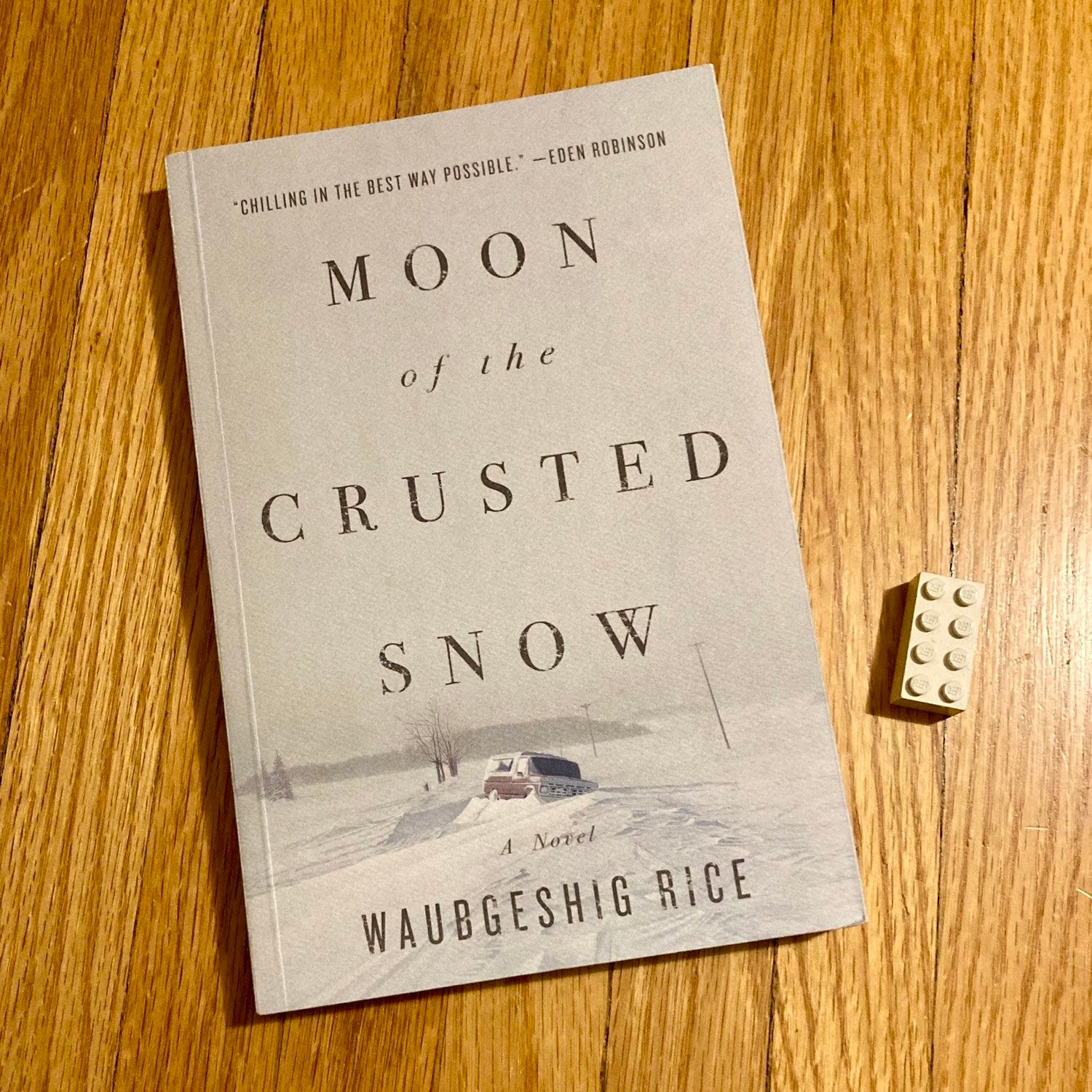
Moon of the Crusted Snow, Waubgeshig Rice: A deft thriller set in Northern Ontario, in a remote Anishinaabe village. The village has been modernizing, but Evan and a few others have been keeping the old traditions alive as well as they can. These become essential when the power goes out, and the satellites and phone lines go down. Some kind of catastrophe has happened down South, but all they know is that they are on their own to survive. Or would be, until some people start arriving from the south, looking for refuge, but bringing more trouble than help. This is a powerful yet simple story, woven throughout with the Anishinaabe words and traditions. As such it is not only a dark, chilling tale of survival, but also part of a cultural reclamation of story and language. I thoroughly enjoyed it. (Oct)
Breakfast at Tiffany’s, Truman Capote: The story that launched the movie that cemented Audrey Hepburn as Holly Golightly in our imagination. Holly is beautiful, young, seemingly carefree, but also a victim, scared, desperate to cash in on life. She has many acquaintances, admirers, paramours, but few friends. And she is caught up in impending disaster. It reads as comedy, but really there is tragedy in her story, though Holly only lets that slip once or twice. (By the by, I got to meet Audrey Hepburn once, and she was as classy as anything.) (Oct)
Giovanni’s Room, James Baldwin: Baldwin is one of the great writers of the 20th century, and maybe of all time. This novel tells the story of David, a young American man in Europe, wrestling with his sexuality as he becomes embroiled in Paris’ gay hidden world of poor boys and the older men who preyed upon them. David is hiding his nature from himself and from his fiancée, Hella, as he takes residence in Giovanni’s room. Giovanni is a young, beautiful Italian man who becomes David’s lover, until things end tragically. It is a story of self-loathing, social mores and hidden ways, American versus European society and culture, men and women, and the desperate plight of humanity in need of the “heavy grace” of God. A sad, but powerful novel. (Nov)
DreadfulWater, Thomas King: I really like King and try to read everything I can find of his. This is the first in the DreadfulWater series, about a former cop, now photographer, named Thumps DreadfulWater. Thumps is Cherokee, and he has moved from California to Chinook on the prairies, hoping to escape his past and live a quiet life. No luck, as a murder interrupts the planned opening of a resort and casino in the local reserve, and Thumps has to try to figure things out and protect the life of his lover’s son who has become the prime suspect. Good stuff, not deep, but a genuine who done it with all the humour and true characterization King brings to his books. (Nov)
The Red Power Murders, Thomas King: The further adventures of Thumps DreadfulWater, ex-cop whose past keeps on coming back to haunt him. This time it materializes in the form of former friends in the Red Power Movement, a natives-rights organization that had been at the centre of a raid and some deaths many years before. Thumps had known the principles, and what had been kept secret is now coming to light. King writes in an engaging, entertaining and accessible way, and it is a joy to spend time in his universe. (Nov)
Cold Skies, Thomas King: There sure are a lot of murders in sleepy little Chinook, home of retired Cherokee police officer Thumps Dreadwater. Third book in the series, and the best part is the long drawn out characters. (Dec)
The Round House, Louise Erdrich: Young Joe Coutts lives on a reservation in North Dakota in the 80’s with his father, a tribal judge, and his mother, the tribal archivist. It is something of an idyllic life of best friends, bike rides, Star Trek,and burgeoning hormones until his mother comes home one day having been brutally raped near the Round House, the spiritual center of the reservation. The rest of the story is the unpacking of the crime and the mystery from the perspective of Joe, as he seeks to rescue, protect, then avenge his mother. Complicating the story is the very real-life horror that one in three Native women report sexual assault (the number is probably higher), and 86% of those assaults are committed by non-Native men. But in the 80’s, and in some places still today, the mess of jurisdiction issues means that many of these crimes go unprosecuted, a fact known by and exploited by the antagonist in this story. This book is extremely well-written and engaging, the characters fleshed-out and often hilarious, and the mystery at the heart of it is compelling and horrific.